
“Many times, we had to improvise”: Supporting healthcare in Mozambique

Sabina after giving birth in Nanhala Health Center.
“Before this centre was fully equipped, I was very afraid of giving birth,” Sabina says. “I kept thinking: What if my baby cannot breathe?”
It’s 2am when the 23-year-old arrives at the 9 de Fevereiro Health Centre in Nanhala, in labour and exhausted. In this corner of the Cabo Delgado province, seeking care often starts with a longer journey: 30 to 45 kilometres for prenatal check-ups or delivery support, sometimes while contractions are already coming. However, reaching a facility doesn’t always end the uncertainty. Basic equipment such as beds, sterile supplies or neonatal aspirators might not be available.
Sabina had therefore already braced herself for improvisation. But instead, she walked into a room that was ready.
“There was a delivery bed. Enough light. The midwife had what she needed,” she recalls. A neonatal aspirator was within reach, an oximeter available to monitor her baby, and the space felt clean. “For the first time, I felt truly safe,” she says.
Less improvisation
Sabina’s story is personal, but it points to something systemic: what changes when a health facility moves from coping to functioning in a region where clinicians are expected to carry risk with too few resources, day after day.
Together with ForAfrika, we helped deliver $633K worth of medical equipment and supplies intended to strengthen maternal and newborn care at Nanhala, alongside infection-prevention materials.
Jamal Momade, Director of the 9 de Fevereiro Health Centre, describes what that shift means in practice:
“We were operating with very limited resources,” he says. “Many times, we had to improvise.” The result, he adds, was constant pressure on staff and higher risks for patients.
The pressure hasn’t disappeared. Births still come at night, emergencies still arrive without warning, and staff still work under constraints. But there is a difference between scarcity and uncertainty. With fundamentals in place clinicians can spend less time compensating for what’s missing, and more time providing care.
The project at hand
The content of the 40ft container was initially designed to equip the Level II Health Centre in Nanhala. But after a joint verification with Mozambique’s Central of Drugs and Medical Supplies (CMAM) and health authorities, it became clear the shipment could be used responsibly beyond a single facility. With approval from the Provincial Health Directorate, the project expanded from one site to five:
Nanhala Health Centre
Mueda Rural Hospital
Pemba Provincial Hospital
Natite Health Centre
Nagalane Health Centre
Across these facilities, 300,852 medical items were delivered, supporting an estimated 88,510 people, including displaced families, host communities and vulnerable women and children.
And the demand is tangible: In a single month during the reporting period, the five facilities collectively recorded 23.644 consultations, spanning antenatal care, outpatient treatment, and basic emergency support. For health workers, that volume is a constant reminder of how quickly supplies are consumed and how easily a shortage becomes the difference between timely care and delayed care. This shipment was designed to narrow that gap: sustaining routine services, easing stockouts and enabling staff to respond to complications locally rather than relying on distant referrals.
Cabo Delgado’s overlapping crises
Cabo Delgado remains one of Mozambique’s most fragile provinces and has spent years under overlapping pressures from insecurity to displacement, and climate shocks that repeatedly weaken already fragile services.
In 2025, renewed violence contributed to an estimated 43,000 newly displaced people in just a few months, with more than 134,000 people directly affected by violent incidents. Families move, livelihoods fracture, and health services absorb the consequences, often without the staff or supply that is needed.
At the same time, extreme weather keeps raising the stakes. During the 2024–2025 rainy season, multiple cyclones damaged at least 183 health facilities nationwide. In Cabo Delgado, more than half of facilities are reported to be partially functional or non-functional, meaning care is often delivered in conditions that are already compromised before a patient even arrives.
And beyond the headlines, many facilities already lack reliable basics like water and sanitation, which undermines infection prevention and safe treatment, especially in maternal and newborn care, where “small” protections can carry life-or-death weight.
Making aid reach further
Our medical program is framed around leverage. Through a strategic network of partners, we are able to source and deliver supplies at far lower cost and make better use of every resource by matching the right items to individual health facilities needs.
Through our partner Project C.U.R.E., we were able to send medical supplies valued at $633,387 to Mozambique for less than 40.000 EUR, thereby multiplying the value of the support roughly seventeenfold!
ForAfrika not only financed the project, but also brought their deep operational presence in Mozambique, built over more than 40 years.
Working in close coordination with health authorities, distribution was adapted to facilities’ clinical settings and routed across different levels of care, from community health centres to referral hospitals, so the shipment strengthened services in practice, rather than ending as a one-off gesture.
“After everything I experienced," Sabina reflects, "I can see how this health centre has transformed my life and the lives of many other mothers. With the new equipment, skilled staff, and a safe space, we feel confident and treated with dignity. Our babies now have a better chance of being born healthy and receiving proper care from the very first minute. This investment has helped me, and it will continue to benefit many families in our community for generations to come."
For Sabina, it meant a night that didn’t end in fear. It meant a midwife who didn’t have to improvise. And it meant that when her baby struggled, help was not simply a matter of luck but rather within reach.
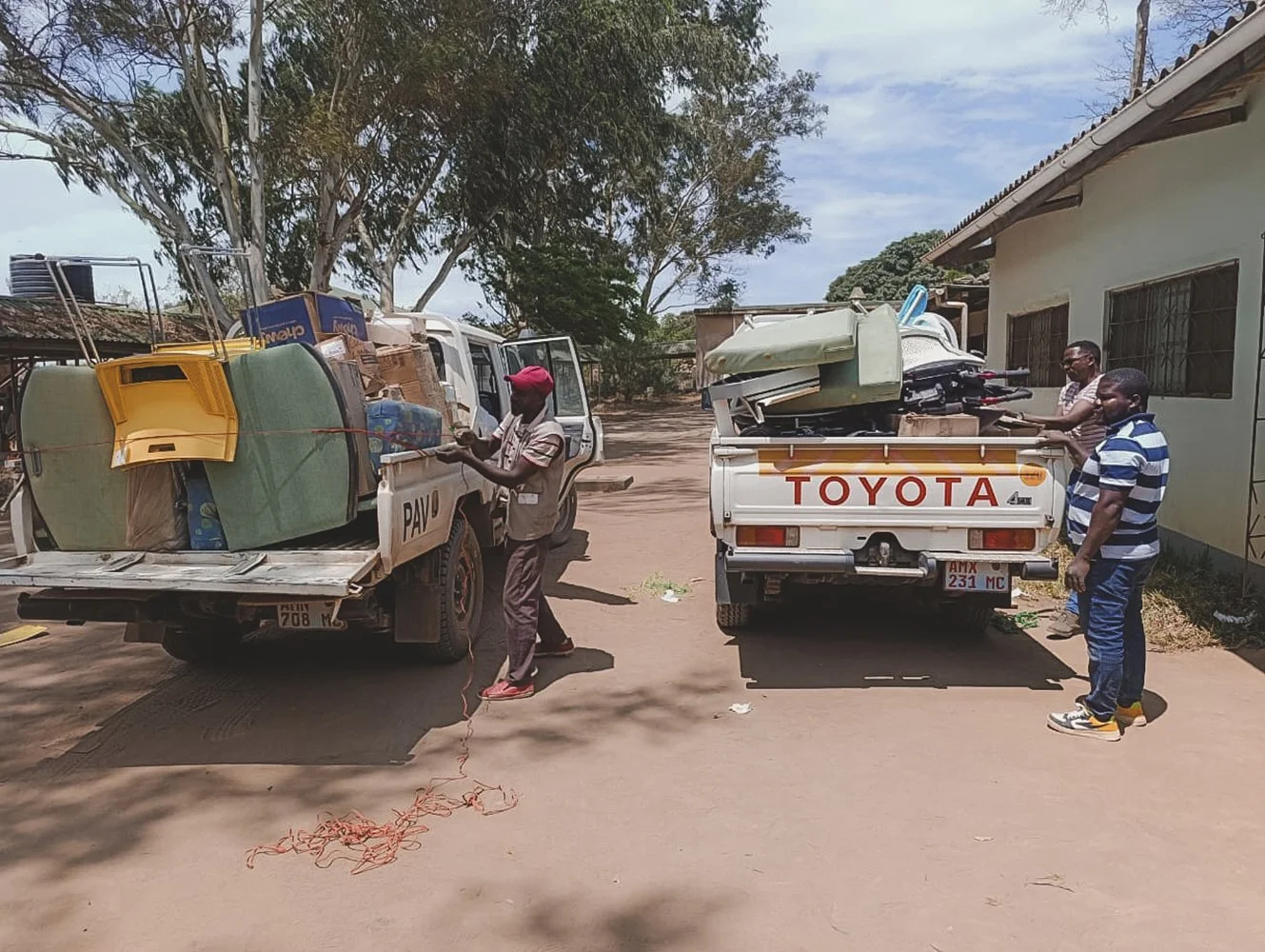

Offloading of the medical supplies at 9 de Fevereiro Health Centre.

Jamal Momade Mueda, District Director of Health, together with the ForAfrika team.
